
Genworth Financial
Adaptive Coherence | Operating Model
Years: 2026 - Present
DILEMMA
The team existed and the theoretical case for a coupled research-and-design function had been made — but in practice the connection didn't hold at scale. Insights struggled to consistently reach the experiences being designed, and what the team learned had limited broadcast across the organization. The function was in place; the system connecting it to organizational action was not.
OBJECTIVE
Design an operating model that lets the research and design function serve as an organizational system — one that senses customer reality, interprets what signals mean, aligns the organization around that reality, and responds coherently — so that execution follows evidence rather than instinct or outside-in assumption.
ROLE Organizational Designer | CAPABILITIES Organizational Design, Systems Thinking, Sensemaking, ResearchOps, DesignOps, Governance, Cross-Functional Alignment, Dual-Track Research Operating Model Design | STATUS Ongoing
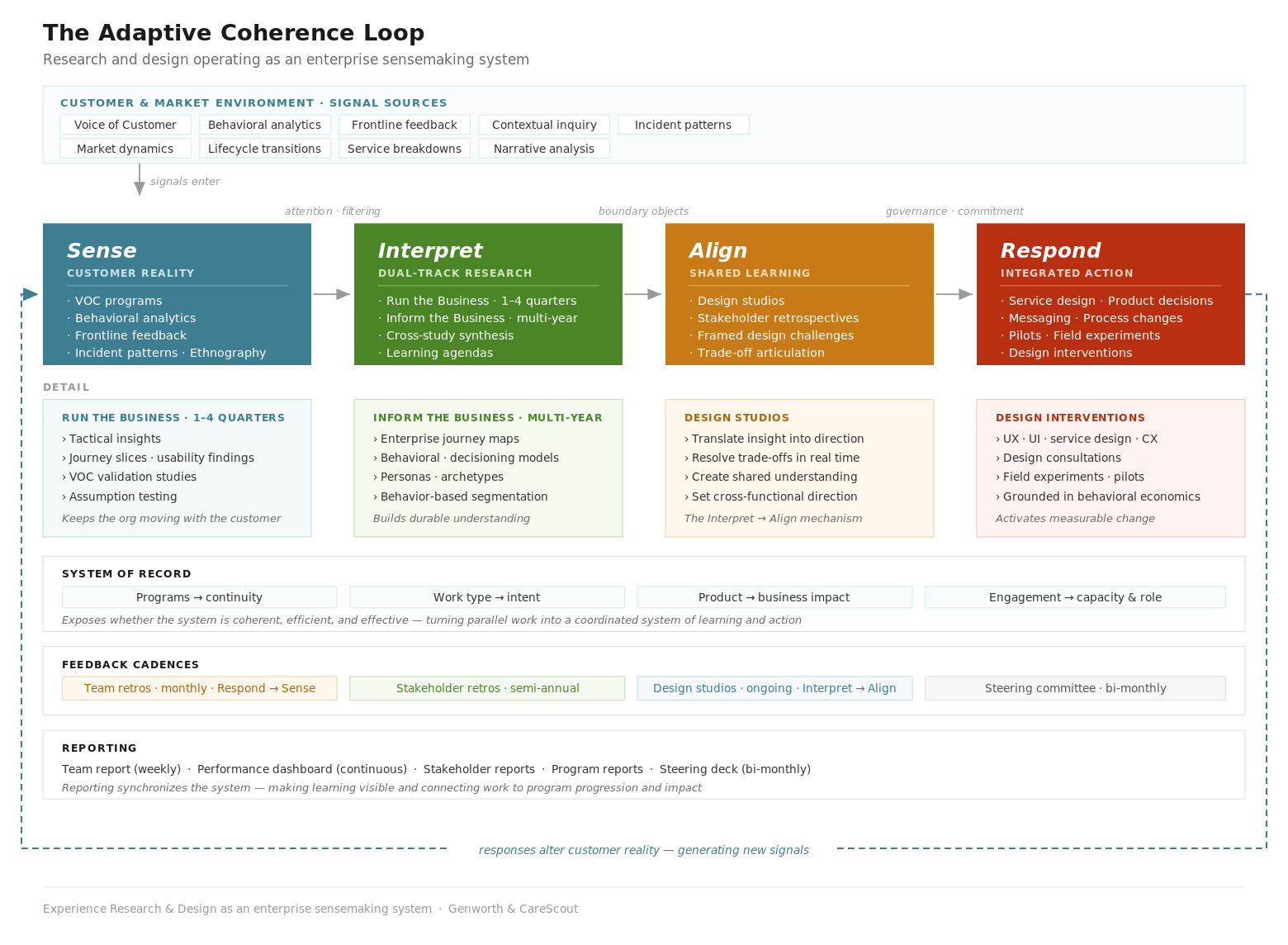
The full system view. Signals enter through Sense, are interpreted across two research horizons, become shared understanding in Align, and drive integrated action in Respond — where responses alter customer reality, generating new signals that re-enter sensing.
PROCESS
Sense — customer reality. Signals enter continuously from across the customer and market environment: VOC programs, behavioral analytics, frontline feedback, contextual inquiries, incident patterns, market dynamics, lifecycle transitions, service breakdowns, and narrative analysis. The work of this stage is attention and filtering — deciding what deserves interpretation.
Interpret — dual-track research. Run the Business operates on a near-term one-to-four-quarter horizon: tactical insights, journey slices, usability findings, VOC validation studies, and assumption testing — the work that keeps the organization moving with the customer. Inform the Business operates on a multi-year horizon: enterprise journey maps, behavioral and decisioning models, personas and archetypes, behavior-based segmentation, and emerging themes. Cross-study synthesis and standing learning agendas connect the two, so near-term findings accumulate into durable understanding rather than evaporating after delivery.
Align — shared learning. Interpretation becomes shared understanding through design studios and stakeholder retrospectives, where insight is translated into direction, trade-offs are resolved in real time, and cross-functional teams arrive at a common view. This is where coherence is actually produced: the organization aligning around customer reality and evidence rather than instinct and an inside-out view of its own business.
Respond — integrated action. Shared direction becomes action: service design, product decisions, messaging, process changes, pilots, field experiments, and design interventions, grounded throughout in behavioral economics.
Closing the loop. Responses alter customer reality, generating new signals that re-enter sensing — the mechanism that makes the model adaptive rather than linear.
The infrastructure underneath. ServiceNow serves as the system of record, mapping programs to continuity, work type to intent, product to business impact, and engagement to capacity and role — exposing whether the system is actually coherent, efficient, and effective, and converting parallel work into a coordinated system of learning and action. Four feedback cadences keep the loop calibrated: monthly team retrospectives (Respond → Sense), ongoing design studios (Interpret → Align), semi-annual stakeholder retrospectives (Align → Respond), and a bi-monthly steering committee for visibility. A reporting layer — weekly team reports, a continuous performance dashboard, stakeholder and program reports, and a bi-monthly SteerCo deck — synchronizes the system by making learning visible and connecting work to program progression and impact.
TENSIONS NAVIGATED Several persisted throughout. Bandwidth was a constant constraint — sustained pressure to produce more without proportional resourcing. That scarcity created political pressure: stakeholders competed to monopolize the team's capacity, and influence over the customer experience space was actively contested as the organization evolved. The most consequential tension was structural — a recurring pull toward reorganizing along functional lines, which would have dismantled the system-oriented design the model depends on to work at all.
RESULTS
Greater organizational coherence around a shared, evidence-based understanding of customer reality
Increased throughput without proportional growth in resourcing
Stronger customer experiences, designed from evidence rather than instinct
Foundational and nuanced customer understanding built as a durable asset, not a series of one-off findings
Ideation and brainstorming rooted in rigorous, evidence-based approaches
Information silos broken down — learning broadcast across the organization rather than trapped inside individual teams
This model is the practical implementation of the construct my dissertation examines theoretically — adaptive coherence, taken from theory into operating practice inside a live enterprise.