
Genworth Financial
Service Design
Years: 2024 - Present
DILEMMA
The Moment of Claim is where a long-term care policy's promise is finally tested — and the people navigating it are rarely positioned to navigate anything well. Research found the primary user is usually not the policyholder but the policyholder's care circle: family members coordinating care for someone who now needs it. The work also deliberately accounted for solo agers, policyholders facing this without family support at all.
What they encountered was an operating model built like an assembly line. Claims moved between functions with poor handoffs and little coordination, and the consequences landed directly on customers: people received different narratives about their own claim depending on who they happened to reach, and payments were delayed by the same coordination failures. Poor operational metrics, poor CX metrics, and strong Voice of Customer signal all pointed at the same root cause.
OBJECTIVE
Create a coherent, low-friction customer experience at this moment of truth — and prepare the organization for the surge in claims volume coming as the Baby Boomer generation ages.
ROLE Research Program Manager, UX Design Strategy, Voice of Customer, Service Designer | CAPABILITIES Journey Mapping, Voice of Customer, UX Research, Service Design, UX Design Strategy, Message & Concept Testing | STATUS Ongoing
Part of a Multi-Year Strategic Plan for customer-centric transformation at Genworth/CareScout.
PROCESS
A three-year transformation, structured in phases.
Phase I (Year One) — establishing what actually matters. Customer insights work identified the real drivers of satisfaction. Three surfaced clearly: a single point of contact who genuinely understands the policyholder's situation; digital communication for the aspects where it's appropriate; and visibility into where the claim stands — the absence of which was a persistent source of anxiety.
The most immediately actionable finding was narrower, and its consequences were larger than expected: the IVR experience alone accounted for roughly 80% of all complaints. Modernizing it, alongside moving to onshore representatives, reduced complaint volume dramatically. The second-order effect mattered more than the first — with one dominant complaint suppressing everything else, the organization had been effectively blind to the rest of the experience. Clearing it let the other drivers surface where they could finally be addressed.
Phase II (Year Two) — restructuring the service model. Journey mapping, Voice of Customer, UX research, and service design were combined to replace the assembly line with a spoke-and-wheel model. The model was proven through piloting, then scaled as capacity grew, and instrumented through VOC and CX metrics from the outset rather than assessed after the fact.
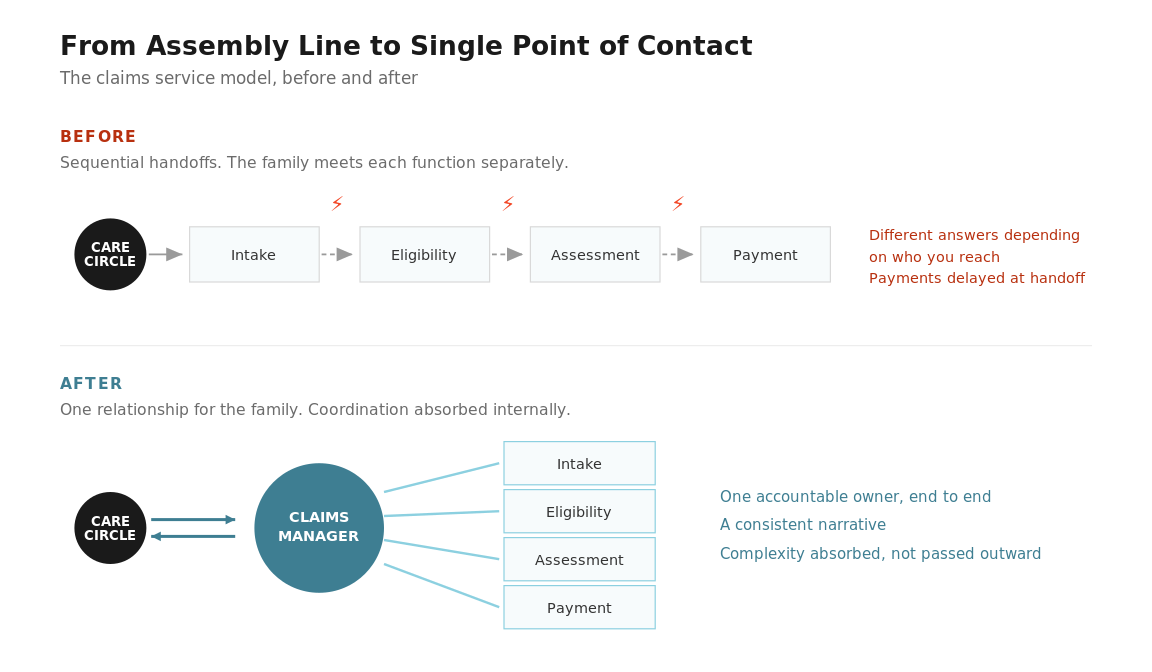
Replacing sequential handoffs with a single accountable owner. The family gets one relationship; coordination complexity is absorbed internally rather than passed outward.
Phase III (Year Three, current) — eligibility and ongoing support. Work now focuses on refining the initial eligibility portion of the claims experience and standing up an Ongoing Eligibility service model built on the same principle as the claims manager — a claims concierge. Alongside it, Voice of Customer, UX design, and message and concept testing were applied to the claims correspondence itself. The letters had been written verbosely and were difficult to comprehend, drafted from the organization's perspective rather than the customer's; rewriting them was a direct application of the enterprise service standard on clear, plain language, supported by a standing VOC system to keep the experience calibrated.
The portal — a parallel track. Redesigning the notice of claim experience produced a 20% increase in funnel completion. Two further capabilities are in discovery, with builds expected in 2027: a claims tracker that gives families visibility into where their claim stands — answering the third satisfaction driver identified in Phase I — and a secure message center.
TENSIONS NAVIGATED Three persisted. The first was evidentiary: proving the model worked before it had a track record, which meant building the case while the change was still underway. The second was operational — early on, the feedback loops had to be run manually, which constrained how quickly the team could learn and adjust. The third was relational: earning a genuine partnership with operations, moving from a function that studied the experience to one invited to the table to help shape it.
RESULTS
Status: three years in and ongoing. Phase III and the portal capabilities are still in flight.
15-point increases in both NPS and CSAT following the service model change, supported by positive Voice of Customer signal
IVR modernization addressed roughly 80% of total complaint volume — and, more consequentially, restored the organization's visibility into the problems that volume had been masking
20% increase in notice of claim funnel completion following the portal redesign
A single accountable point of contact replacing assembly-line handoffs — resolving the inconsistent-narrative and delayed-payment failures at their root
Claims manager model piloted, proven, and scaled; claims concierge model now extending the same principle to ongoing eligibility
Claims correspondence rewritten in plain, customer-centered language
Standing VOC instrumentation to keep the experience calibrated over time