
Genworth Financial
Behavioral Experimentation
Year: 2025-2027
DILEMMA
When Genworth takes a rate action, long-tenured policyholders face a consequential choice: pay a higher premium on a policy they may have held for decades, or reduce their benefits to keep the premium manageable. It is a decision about care they may need years from now, made under real uncertainty, often by people who have not thought closely about their policy in years. Genworth lacked foundational, nuanced insight into how customers actually navigate this moment — a gap that limited both the quality of the decisions customers were making and the organization's ability to manage the operational and strategic risk carried in higher-risk portfolios.
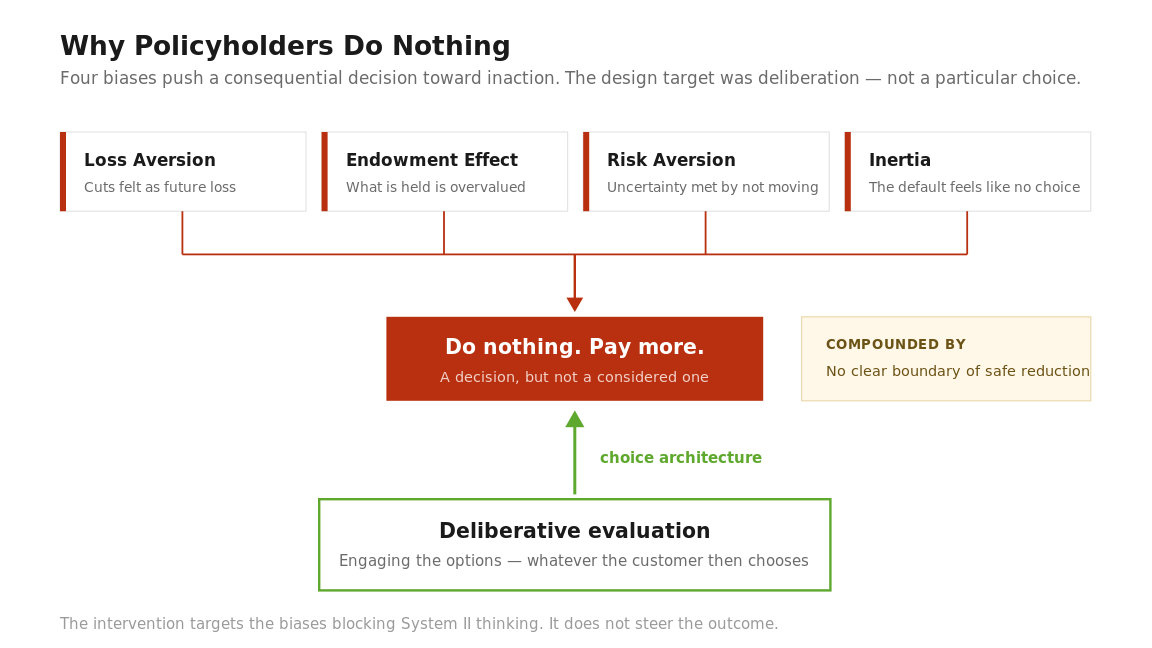
Four biases converge on inaction. The design target was restoring deliberation — not moving customers toward any particular choice.
OBJECTIVE
Build a clear understanding of customers' actual reality, journey, and decision-making within Reduced Benefit Options (RBO) contexts, and use it to shape three connected design efforts: the RBO catalyst, the choice architecture of the selection form, and a bi-modal service model blending human-guided and self-service experiences for customers working through the decision.
ROLE Behavioral Theorist, Behavioral Strategist, Research Program Manager, Service Designer | CAPABILITIES Choice Architecture, Behavioral Economics, Qualitative & Quantitative Research, Experimental Design, Service Design, Double-Diamond Design Process | STATUS Ongoing
Part of a Multi-Year Strategic Plan for customer-centric transformation at Genworth/CareScout.
PROCESS
Understanding the decision. This work shared a research program with the behavioral segmentation effort — a deliberate orchestration that let a single body of research answer several enterprise questions at once. The dimensions that emerged there (Financial Capability, Willingness to Engage, Vulnerability) turned out to be the dimensions that matter most in how a policyholder approaches an RBO decision. (See: Behavioral Customer Segmentation for the full research methodology.)
The biases in play. Research surfaced four cognitive biases consistently present when policyholders face this decision: loss aversion, the endowment effect, risk aversion, and inertia. Together they push customers away from deliberative evaluation and toward doing nothing — which is itself a decision, just not a considered one.
Choice architecture experiments. The selection form is the document a policyholder actually uses to decide whether to reduce benefits. We designed multiple versions of it, each constructed to address a different one of the identified biases, and tested which was most effective at prompting customers to genuinely evaluate their options rather than default into inertia.
The bi-modal service model. The redesigned experience runs on two parallel modes. In the guided mode, catalysts are sent to open a conversation, followed by proactive outreach to assess the customer's coverage — a conversation supported by an illustration engine that contextualizes each option against what the customer believes their future needs will be. In the self-service mode, a consumer portal experience lets customers run that same assessment independently, at their own pace.
Upstream education. Alongside the decision experience itself, the team developed educational content delivered as a drip campaign across the customer journey, so that policyholders arrive at an RBO decision already informed about their policy benefits rather than encountering the details for the first time under pressure.
DESIGN ETHIC The goal was never to move customers toward reducing their benefits. Reducing coverage is the right answer for some policyholders and the wrong answer for others, and the design intent was explicitly not to influence which way any given customer went. What the work targeted was the cognitive biases that block policyholders from System II thinking — the slow, deliberative reasoning a decision of this consequence deserves. Success meant a customer genuinely engaged with their options and made a considered choice, whatever that choice turned out to be.
TENSIONS NAVIGATED The hardest part was getting stakeholders to value foundational understanding before strategy rather than after it. The shift happened gradually: as stakeholders began coming to research for the nuanced understanding they needed to evaluate their own strategies, research moved from a downstream validation function toward an early partner in shaping direction. Demonstrating the value of Inform the Business research on this program produced a trickle-down effect across how specific initiatives were subsequently scoped and sequenced.
RESULTS
A cohesive set of engagement strategies built on evidence-based hypothesis testing rather than assumption
Selection form variants designed and now in testing against four identified cognitive biases, targeting deliberative evaluation over inertia
A bi-modal service model — human-guided and self-service — supported by an illustration engine that contextualizes options against the customer's own expectations of future need
Upstream educational content delivered across the customer journey, so policyholders arrive at the decision already informed
Organizational ability to customize experience and engagement based on observable behavioral traits rather than declared preferences
Research established as an early strategic partner rather than a downstream validation step