
Genworth/CareScout
Experience Design Capability
Years: 2021 - Present
DILEMMA
I joined Genworth shortly after a reorganization and significant layoff that hit marketing hardest. What remained was a lone researcher and no UX design function at all. Research and design operated separately — research produced insights that frequently went nowhere, unable to reach the point where they could change an actual experience. For work requiring design capability, the organization relied on outside contractors who didn't understand its nuances, with no internal skillset to build on.
OBJECTIVE
Build an enterprise research and design capability from zero — not a team that produces deliverables on request, but a coupled research-and-design function positioned early enough in strategy formation to shape decisions rather than validate them after the fact.
ROLE Employee #1 → Director of Research & Design | CAPABILITIES Human-Computer Interaction, Behavioral Analytics, Iterative Design Process, User Research, ResearchOps, DesignOps, Governance, Organizational Design | STATUS Ongoing
Part of a Multi-Year Strategic Plan for customer-centric transformation at Genworth/CareScout.
PROCESS
Starting as a team of one. I was hired as the first member — a UX designer with an HCI background in behavioral analytics, iterative design, and user research. The early strategy was straightforward: demonstrate value on real problems, then convert that credibility into resources. Each success justified the next hire.
Consolidating research and design. The structural problem was that research and design weren't coupled — insight and execution lived apart, which is why findings so often failed to reach the experience. Over time the organization reorganized to bring both under a single leader, and I was positioned in that role. This wasn't mine alone: my supervisor, the product leader for digital customer experience and business transformation, had product owners reporting to him, and together we built the case for a unified enterprise CX organization. The result was Customer Experience Solution Delivery — named for the combined capability to learn, design, and execute.
Building the operating infrastructure. Growth created its own problem: adding people without degrading how the team worked. That required process mapping across both functions, a set of team guiding principles and values, a project operating system, operational metrics, and standing intervention forums to improve how the team operated over time. We also worked out how to incorporate AI into our workflows without eroding SME autonomy or the sensemaking work that makes research valuable in the first place.
Managing demand. As demand outpaced capacity, we established steering committees and a dual-track research demand model — Inform the Business (generative, exploratory) and Run the Business (execution support for strategy already in motion). The operating principle was an in-house team capable of absorbing the majority of enterprise demand, outsourcing only the larger projects that would otherwise compromise throughput. (See: Adaptive Coherence Operating Model.)
TENSIONS NAVIGATED Two persisted throughout. The first was a recurring gap between recognition and resourcing — the organization acknowledged the team's value faster than funding matched the demand it generated. The second was political: as the organization evolved and new leaders arrived, the customer experience space attracted others seeking influence over it, which meant continually re-establishing the function's mandate rather than assuming it was settled.
RESULTS
Grew the function from one person to a nine-person multidisciplinary team spanning behavioral science, customer intelligence, experience measurement, UX and UI design, and CX strategy
Replaced dependence on external contractors with internal capability that understood the organization's nuances
Research and design earned standing at strategic tables — brought in early to shape strategy rather than downstream to validate it
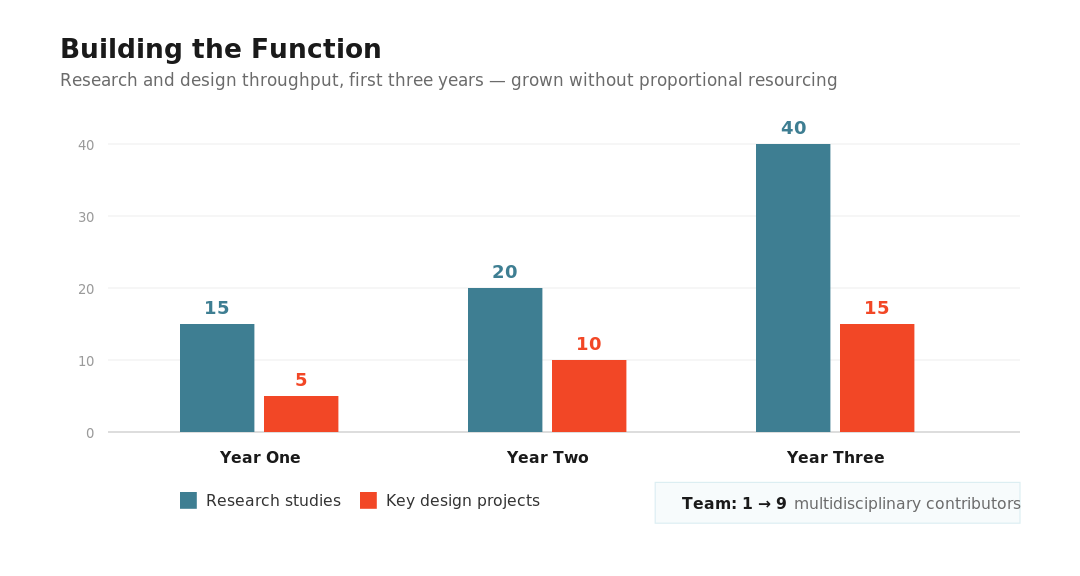
Throughput roughly tripled over three years while the team grew from one person to nine — capability compounding rather than scaling linearly with headcount.