
Genworth/CareScout
Voice of The Customer Program
Years: 2025 - Present
DILEMMA
Voice of Customer existed only in pockets — almost entirely within operations, in the form of a post-call survey used to calibrate customer service interactions. NPS was the only metric, and it was being read as a relational signal when what it actually captured was transactional: satisfaction with a single agent interaction. There were no relational measures, no governance for cross-enterprise experiences, and no unified statement of what the organization was trying to deliver. The gap surfaced as part of a broader customer-centric transformation — the organization had begun investing in CX capabilities without a clear way to measure CX or translate it into action.
OBJECTIVE
Create a unified VOC and CX strategy for the entire enterprise — spanning two distinct brands — and operationalize it: not just define what good looks like, but build the measurement architecture, governance, and shared standards required to pursue it.
ROLE Strategist, Workshop Facilitator, Thought Leader | CAPABILITIES Enterprise VOC Strategy, CX Measurement Design, Governance, Change Management, Cross-Functional Alignment | STATUS Ongoing
Part of a Multi-Year Strategic Plan for customer-centric transformation at Genworth/CareScout.
PROCESS
Diagnosing the measurement problem. The first task was educating leadership on a distinction the organization had been eliding: transactional versus relational signal. The existing post-call NPS was being treated as a measure of the customer relationship, but the qualitative feedback within the loop made plain what it actually measured — agent interactions. What leadership believed about relationship health was being inferred from a signal that couldn't support the inference.
Rebuilding the measurement architecture. We added CSAT and CES alongside NPS to capture dimensions a single metric couldn't. We then separated relational measurement from the transactional setting entirely, establishing an email-based relational survey on a regular cadence — deliberately timed to avoid moments that would produce a false read on the relationship. Feedback loops were expanded across key points in the customer journey rather than over-indexing on a single touchpoint, and survey deployment was coordinated across the enterprise to reduce customer survey fatigue.
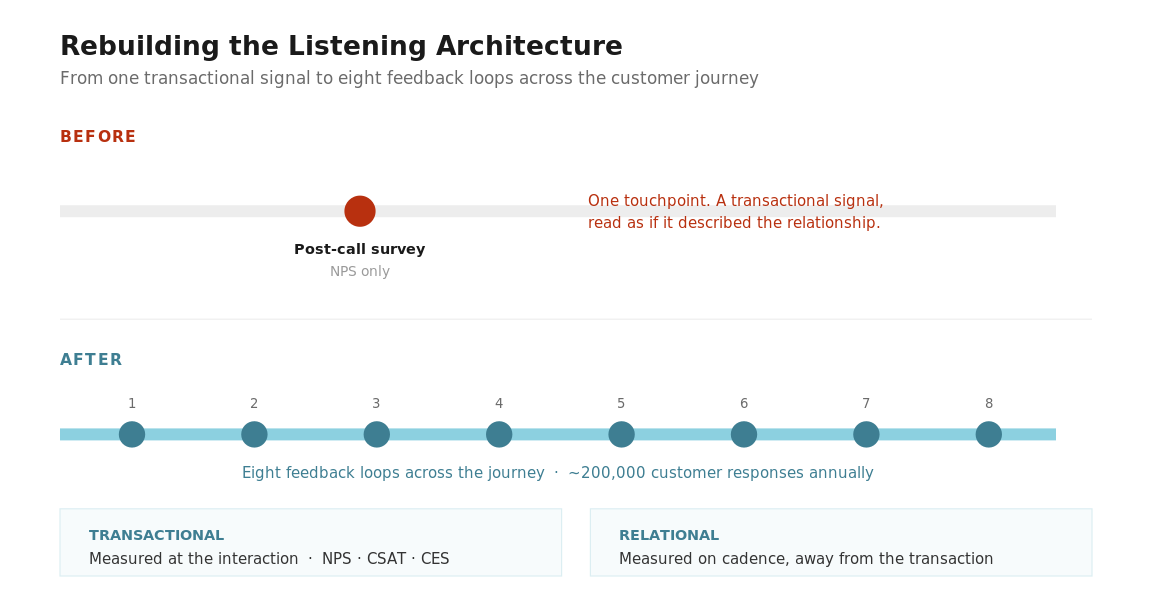
From a single post-call survey read as a relationship measure, to eight loops across the journey — with transactional and relational signal separated by design.
Establishing shared intent and service standards. The organization had no unified intent statement or service standards before this work. Through cross-functional workshops, we identified and voted on standards the enterprise could rally behind, anchored in a CX intent statement:
We are committed to making our customers feel cared for, understood, and empowered at every stage of their aging journey by delivering timely, compassionate, and personalized experiences that meet customers where they are.
Three standards followed:
Empathy and understanding — actively listen to customers, through direct interactions and solicited feedback, and act on their needs promptly, so they feel heard and valued throughout every interaction.
Customer empowerment — communicate in clear, plain language, with applicable resources and channel preferences, so customers fully understand their options and feel confident in their decisions.
Getting it right the first time — take ownership and accountability for every touchpoint in the customer experience, investing in the technology and people that deliver timely, accurate service.
Standing up governance. Working groups were established to develop and execute the strategy, with embedded ambassadors placed in key product areas so the work had presence where decisions were actually made, supported by metric dashboards that made performance visible.
Connecting experience and operational data. The organization invested in Qualtrics as its CX management platform and Power BI for enterprise reporting — infrastructure that brought X-data (experience) and O-data (operational) together as one system for understanding customer reality, rather than two disconnected sources.
TENSIONS NAVIGATED The hardest part was ensuring everyone felt accounted for. Building a single enterprise strategy across Genworth and CareScout meant rallying two distinctly different brands — with different customers, propositions, and cultures — around shared direction, without either feeling its reality had been flattened into someone else's.
RESULTS
Grew from a single feedback loop to eight across the customer journey — roughly 200,000 customer responses annually
A unified CX intent statement and three service standards where none existed before — a shared reference point the entire enterprise could rally behind
A measurement architecture that distinguishes relational from transactional signal, with CSAT and CES added alongside NPS
Coordinated survey deployment across the enterprise to reduce customer survey fatigue as coverage expanded
CX metric dashboards for executive stakeholders
X-data and O-data operating as a cohesive system for understanding customer reality
Stronger cross-enterprise alignment and tangible improvement at key moments of truth